



Article I Zone Based Regulations
RZC 21.03 R-4 Single-Family Urban Residential 
- A.Purpose. The R-4 Single-Family Urban Residential zone provides for primarily single-family residential neighborhoods on lands suitable for residential development with an allowed base density of four dwellings per gross acre. This designation provides for stable and attractive suburban residential neighborhoods that have a full range of public services and facilities. To complement the primarily residential nature of these zones, some nonresidential uses are allowed.
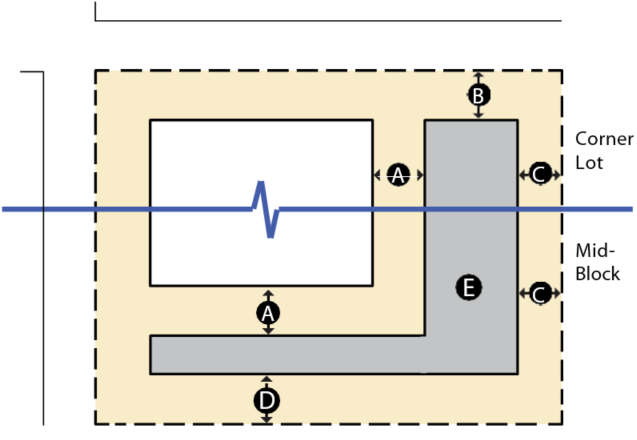
| Figure RZC 21.03A Typical Subdivision Layout R-4 |
 |
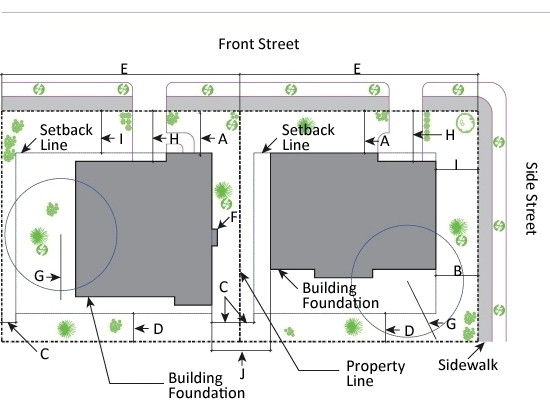
| Figure RZC 21.03B Typical Site Layout R-4 |
||||||||||||||||||||||
|
This sketch represents maximum allowance for structures, impervious surface & setbacks
|
||||||||||||||||||||||
- B.Maximum Development Yield. The following calculation provides a potential maximum development yield for a development utilizing the density bonuses available for the R-4 zone. The calculation is based on a development occurring on a one-acre lot. Please note that accessory dwelling units do not count toward maximum development yield.
| Table RZC 21.03A Maximum Development Yield |
||
| Base Density | Available Density Bonuses | Maximum Density |
|
4 dwelling units per gross acre |
Cottage Development: Up to 1.75 cottages allowed in place of each standard size dwelling unit |
7 dwelling units allowed |
|
Green Building/Green Infrastructure Development: Up to 10 percent of base density |
0.40 dwelling units allowed |
|
|
Affordable Housing: Up to 15 percent of base density |
0.60 dwelling units allowed |
|
|
Total = 8 dwelling units per gross acre |
||
- C.Regulations Common to All Uses.
| Table RZC 21.03B Regulations Common to All Uses |
|||
| Regulation | Standard | Exceptions | |
| Minimum |
Average Lot Size |
7,000 square feet | |
|
Required Density |
80 percent of net acres | ||
|
Lot Width Circle |
40 feet | ||
|
Lot Frontage |
20 feet | ||
| Setbacks | |||
|
Front |
15 feet |
For zero lot line development, a dwelling unit may be placed on one interior side property line, giving it one zero side/interior setback. If it is an interior lot line, the setback from the other side property line shall be 10 feet. See RZC 21.03.033, Zero Lot Line Development, for additional requirements. |
|
|
Garage |
18 feet |
||
|
Side / Interior (each side) |
5 feet / 10 feet |
||
|
Side Street |
15 feet |
||
|
Rear |
10 feet |
||
|
4 feet |
|||
|
Lake Sammamish |
35 feet |
||
| Building Separation | 10 feet |
Minimum building separation shall be 15 feet in the following neighborhoods: Education Hill, North Redmond, and Willows/Rose Hill. In all neighborhoods, minimum building separation shall be 10 feet for cottages, size-limited dwellings, small-lot short plats, accessory dwelling units, and locations where these structures or cottages adjoin larger dwelling units. |
|
|
Open Space |
20 percent of total lot area |
||
| Maximum |
Lot Coverage for Structures |
35 percent of total lot area |
|
|
Impervious Surface |
60 percent of total lot area |
||
|
Building Height |
35 feet |
30 feet within the Shoreline Jurisdiction |
|
| Drive-through | n/a |
Drive-through facilities are prohibited except where expressly permitted in the Allowed Uses and Special Regulations table below. |
|
- D.Allowed Uses and Special Regulations. The following table contains special zoning regulations that apply to uses in the R-4 zone. To use the chart, first read down the left-hand column titled “Use.” When you have located the use that interests you, read across to find regulations that apply to that use. Uses are permitted unless otherwise specified in the Special Regulations column. Permitted uses may require land use permit approval. See RZC 21.42.002, Overview of the Development Process, for more information. Uses not listed are not permitted.
| Table RZC 21.03C Allowed Uses and Special Regulations |
|||
| Section | Use | Parking Ratio: Unit of measure (Minimum required; Maximum allowed) |
Special Regulations |
| Residential | |||
|
1 |
Detached dwelling unit | Dwelling unit (2.0) | |
|
2 |
Cottage | Cottage (1.5, 2.0) |
Permitted use only in Bear Creek, Education Hill, Grass Lawn, North Redmond, Overlake Residential, and Willows/Rose Hill neighborhoods. See RZC 21.03.023, Cottage Housing Developments, for specific site development requirements and supplemental neighborhood regulations which may apply. |
|
3 |
Small-lot short plat | Dwelling unit (2.0) |
Permitted use only in Education Hill, Idylwood, and Overlake Residential neighborhoods. See RZC 21.03.011.E.2.a.ii, Small Lot Short Plats, for specific regulations which may apply. |
|
4 |
Size-limited dwelling | ||
|
5 |
Accessory dwelling unit (ADU) | ADU (1.0) |
|
|
6 |
Attached dwelling unit, 2-4 units | Dwelling unit (2.0) |
|
|
7 |
Manufactured home | Dwelling unit (2.0) |
Please see RZC 21.03.026, Designated Manufactured Homes, Manufactured Homes, and Mobile Homes, for specific regulations which may apply. |
|
8 |
Retirement residence | See Special Regulations |
|
|
9 |
Residential care facility |
A Conditional Use Permit is required. |
|
| 10 | Adult family home | Dwelling unit (2.0) | |
| General Sales or Service | |||
| 11 | Bed and Breakfast Inn | Rental room (1.0) |
Permitted use if no more than two rooms. A Conditional Use Permit is required for inns with between three and eight rooms. |
| Transportation, Communication, Information, and Utilities | |||
|
12 |
Road, Ground, Passenger and Transit Transportation |
N/A |
Regional light rail transit system only. No vehicle storage. |
|
13 |
Adequate to accommodate peak use. | ||
|
14 |
A Conditional Use Permit is required. |
||
|
15 |
N/A |
A Conditional Use Permit is required. Does not include medical airlift. Permitted only abutting Lake Sammamish. |
|
| 16 |
|
||
| 17 |
Wireless Communication Facilities |
See RZC 21.31, Wireless Communication Facilities, for specific regulations that may apply. |
|
| Arts, Entertainment, and Recreation | |||
|
18 |
Adequate to accommodate peak use. |
Includes noncommercial indoor recreation uses, such as community clubhouses, indoor swimming pools, and other similar facilities. |
|
|
19 |
1,000 sq ft gfa (0, adequate to accommodate peak use.) |
Permitted if public or noncommercial. A Conditional Use Permit is required for commercial facilities. |
|
|
20 |
Athletic, sports, and play fields |
Adequate to accommodate peak use.
|
A Conditional Use Permit is required. |
| 21 | |||
| 22 | |||
| 23 | |||
| Education, Public Administration, Health Care, and Other Institutions | |||
|
24 |
Day care center | Employee (1.0) |
A Conditional Use Permit is required. Day care uses are only permitted in a building or building complex used for other uses, such as a school, church, meeting hall, or some other building used for more than one purpose. See RZC 21.03.025, Day Care Centers, for specific regulations which may apply. |
|
25 |
Family day care provider | Vehicle used by the business (1.0). |
Family day care providers are permitted as home businesses. See RZC 21.03.028, Home Business, for specific regulations which may apply. |
|
26 |
Public safety | Adequate to accommodate peak use |
A Conditional Use Permit is required. |
|
27 |
Grade schools (K-12) | ||
|
28 |
Religious Institution |
1,000 sq ft gfa for assembly (1.0) or 5 fixed seats (1.0); 3 seats (1.0). |
|
| Agriculture | |||
|
29 |
Crop production | N/A | |
|
30 |
Equestrian facility |
A Conditional Use Permit is required. |
|
| Other | |||
|
31 |
Home Business |
Vehicle used by the business (1.0). |
See RZC 21.03.028, Home Business, for specific regulations which may apply. |
|
32 |
N/A | ||
|
33 |
Pier, dock, float |
See RZC 21.38.007, In-Water Structures, for special height, setback and area requirements. (SMP) |
|
|
36 |
See RZC 21.38.007.G, Water-Oriented Accessory Structures, for special height, setback and area requirements. (SMP) |
||
(Ord. 2652; Ord. 2744; Ord. 2753; Ord. 2803; Ord.2836; Ord. 2951)
21.03.017 Accessory Structures 


 |
Accessory Structures User Guide |
- A.Purpose. The purpose of the accessory structures provisions is to allow for the opportunity to add additional structures to residential property for the purpose of increased storage space, work space, or other uses that would not qualify it as a dwelling unit.
- B.Applicability. Accessory structures are allowed in all residential zones of the City, as an accessory use to an existing dwelling unit.
- C.Requirements.
- 1.Height. Accessory structures may not exceed 22 feet in height, with the exception of accessory structures which contain accessory dwelling units, which shall not exceed 28 feet in height.
- 2.Size.
- a.Total square footage for the footprint of the accessory structures may not exceed 60 percent of the footprint of the living area on the ground floor (excluding garage) of the primary dwelling unit.
- b.Total square footage for accessory structures which contain accessory dwelling units may not exceed 60 percent of the total square footage (excluding garage) of the primary dwelling unit.
- c.In no case shall the total square footage of the accessory dwelling unit portion of an accessory structure exceed 1,000 square feet.
- 3.Building Separation. Unless the International Building Code or International Fire Code dictates otherwise, there shall be no minimum building separation for accessory structures.
- 4.Location. Accessory structures are prohibited within the front yard setback, with the exception of garages where lot size or lot configuration are not supportive of lessening the dominant appearance of a garage, such as where lot width measured at the front street is less than 50 feet, where steep grades are present, or when compliance with this section would endanger or impair pedestrian and vehicular safety.
- 5.Accessory Structure Setbacks. Side interior and rear setbacks (but not side street) for accessory structures in all residential zones are five feet.
Effective on: 3/29/2014

By: enCode Staff
Date: 7/25/2018
By: enCode Staff
Date: 7/31/2019
By: enCode Staff
Date: 7/31/2019
By: enCode Staff
Date: 8/1/2019
By: enCode Staff
Date: 8/1/2019